Ein Gedi Nature Reserve — Nahal David and ancient synagogue
The walk along Nahal David to David’s Waterfall is deservedly the most popular part of the En Gedi Reserve. Its nearby ancient synagogue is also of considerable interest. The climb to Ein Gedi Spring from Nahal David is not currently operative, but it is possible to hike to the spring and chalcolithic temple via an alternative path. Nahal Arugot is another incredible hike in the reserve. Both hikes are described on separate webpages.
The two Israel travel books that everyone was waiting for!
Bestseller! "In and Around Jerusalem for Everyone - The Best Walks, Hikes and Outdoor Pools" and new! "The North of Israel for Everyone. The Best Family Activities, Hikes and Historic Sites" by Arnold Slyper — with essays, directions, maps, and much more.
For courier service from Pomeranz Booksellers in Jerusalem (tel: 02-623 5559) click here and here. For Amazon click here and here. For details about the books and their outstanding reviews click here and here.
Directions and parking: Enter "Ein Gedi Reserve" into Waze. The entrance to the Ein Gedi Nature Reserve is clearly marked from Route 90. There is free parking outside the entrance to Wadi David.
Admission: This is a park of the Israel Nature and Parks Authority. The reserve is open from 8.00 AM to 4.00 PM in the winter and 8.00 AM to 5.00 PM in the summer. It closes one hour earlier on Friday and holiday eves. A brochure is available in Hebrew or English and contains a map that can be used to follow the hikes described. Especially at popular times it is advisable to book your visit in advance via the internet so that your admission is guaranteed. The admission fee includes admission to Wadi David, Wadi Arugot and the ancient synagogue, although you need to book each separately. In front of the entrance to the reserve is a large covered area with picnic benches that is serviced by stores and restrooms. The reserve phone number is (08) 658-4285. This is their website:
Public transport: Enter "Ein Gedi " into Moovit and click on "Ein Gedi National Park.”

The beautiful David Waterfall
The walk along Wadi David to David’s Waterfall
Before entering the park, it is helpful to look at the pictures on the wall of the animals commonly seen in the reserve. At the very least, you might see an ibex:
-
Follow the crowds towards the scenic waterfalls of Nahal David. The concrete pathway is stroller and wheelchair friendly. At the present time, it is not possible to proceed on the wet trail all the way to David’s Waterfall, although there is still a waterfall to view.
Look carefully at the lower slopes of the cliff and you will notice stone outlines of former terracing. Intensive agriculture was once carried out on the slopes, as well as on the flatter land by the stream. Plants were irrigated by aqueducts from the springs. There is currently no water in the stream, as it is taken for bottling in the nearby factory.
-
Return to the park entrance.

The luscious foliage walking through the wadi

This is a conglomerate rock made from sandstone and pebbles
The ancient synagogue in the Ein Gedi Antiquities National Park.
You can either drive or walk to the ancient synagogue from the parking lot. It is a very short drive. Enter “Ein Gedi Reserve Ancient Synagogue” into Waze. Alternatively, you can walk there along the Oasis Trail. The path begins at the far end of the En Gedi parking lot and immediately crosses two roads.
In the park are tables and chairs and cooled war. A store sells drinks and snacks. A brochure in English is available. A model of the settlement can be viewed.
A Jewish community lived in Ein Gedi in the 3rd to 6th centuries BCE and they did very well for themselves making a product from a secret shrub. Ein Gedi was famous in antiquity for balsam, a shrub from which was extracted an extremely valuable aromatic resin used in perfumes and medicines. Ancient writers describe it as one of the most precious products in the Roman world. An inscription on the synagogue mosaic floor pronounced a curse on anyone revealing the secret of this plant. This curse was obviously effective, since to this day the shrub has not been identified!
The ruins you see of the ancient synagogue and adjacent housing are from the late Roman and Byzantine periods, i.e., from Mishnaic and Talmudic times. The synagogue follows a basilica model commonly used in late antiquity in synagogues and churches, with a rectangular hall, columns and central nave. The area for the Torah ark is on the northern wall facing Jerusalem.
The synagogue has a splendid mosaic. Unlike in some Galilean synagogues, this mosaic has geometric designs and inscriptions, but no human or animal figures other than birds. The mosaics in the synagogues at Beit Alpha and Hamat Tiberias that contain zodiac wheels and human imagery, and even a picture of the sun god. However, as in these other synagogues, it does contain Temple imagery such as menorahs. In all these synagogues, the building was regarded as a “miniature substitute” for the destroyed Temple.
Down the hill from the synagogue are the ruins of a settlement, although only a part of it has been revealed. However, you can walk around the ruins of some of the buildings. The settlement was destroyed by fire and abandoned around the middle of the 6th century CE. A hoard of coins was found in the courtyard of a building, the latest of which was dated to the reign of Emperor Justinian and it is speculated that the settlement was destroyed during a wave of persecution early in his reign.
Beneath these ruins are the remains of an even earlier Second Temple Jewish settlement that extended to the foot of Tel Goren.

The impressive mosaic floor at the ancient Eiin Gedi synagogue
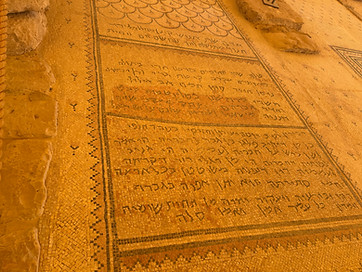
Dedication that includes a curse on anyone who reveals the community's secret.
-
Continue on this trail past Tel Goren. You will pass the Ein Gedi water bottling factory on your left. On the right is a memorial to six youth from the HaShomer HaTzair movement who were killed in 1946 when one of their own grenades blew up.
Nearby Places of Interest:
Highly recommended is a visit to the very beautiful Botanical Garden at Kibbutz Ein Gedi. It is only a few kilometers along Route 90. In actuality, the entire kibbutz is one large, impressive botanical garden! There is a kosher cafe for coffee, deserts, or a dairy meal in the kibbutz hotel.
Consider a water hike in nearby Nahal Arugot, which is also part of the Ein Gedi Nature Reserve.
A visit to Masada is a must. It is a distance of 20 km and about an 18-minute drive from Ein Gedi along Route 90.