Timna Park
Timna is a large park, 60 square kilometers in total, located in the Timna Valle about 30 kilometers north of Eilat. There are many activities that can be done here, and the site may seem a bit overwhelming at first. It is a good idea, therefore, to decide in advance the types of activities that interest you or your family and to plan from there. Although if you come with a tour, your itinerary is already decided upon.
Every English-speaking visitor and resident of Israel will benefit from my two books! Bestseller! "In and Around Jerusalem for Everyone - The Best Walks, Hikes and Outdoor Pools" and new! "The North of Israel for Everyone. The Best Family Activities, Hikes and Historic Sites" by Arnold Slyper — with essays, directions, maps, and much more.
For courier service from Pomeranz Booksellers in Jerusalem (tel: 02-623 5559) click here and here. For Amazon click here. To view details about the books and their outstanding reviews click here and here.
The following activities are available:
-
View the magnificence of the desert scenery by car and stop at the three main sites — namely Solomon’s Pillars, the Mushroom and the Arches. Each will be described in its own section.
-
Take short hikes associated with each of these three sites. The trails are not difficult, but are not easy either. Appropriate footwear and even hiking sticks can be helpful. These hikes will be described in the appropriate section.
-
View the exhibits in the Visitor Center. A major aspect of this park was the production of copper. The production of copper was a very significant stage in human history. This fascinating topic is described in an essay.
-
Keep the kids entertained. The park can do this too! Activities in the lake area include boating on small Timna Lake, doing a free organized sand activity by the lake, and eating in Timna Café. In other words, head to the lake.
-
Take some long hikes. There are a number of long hikes in the park, and these are nicely described on the following website:
Remember that it is extremely hot here in the summer and long hikes and biking should be avoided from May to October.
-
Rent a mountain hike in the park and visit the various sites on a 6-km family, circular route. The path has paved and dirt sections.
-
Examine the religious aspects of the park. A pagan temple can be viewed by Solomon’s Pillars and is described in that section.
-
There is a life-size model of the Jewish Sanctuary by the lake. This is in the park, but has a separate entrance fee.
Directions: Enter “Timna” into Waze and click on “פארק תמנע.“
Admission:: The park is open on Sunday to Friday from 8.00 a.m. to 4.00 p.m. and on Saturday from 8.00 a.m. to 3.00 p.m. You can stay in the park until sunset. Park entry tickets are valid for seven consecutive days and include a complimentary bottle for filling with colorful sand. Some distance from the Visitor Center in the lake area is a café, boats for rental, shaded picnic tables, water, and restrooms. Their phone number is 08 631-6756. This is their website
Public transport: Enter “Timna Park into Moovit. The closest bus stop is a 3-km/37-minute walk.

Solomon's Pillars
-
You first enter the Visitor Center to purchase your entry ticket. This has exhibits of the types of rock found here, namely limestone, sandstone and granite, and rocks containing deposits of copper. Note the exhibit with a copper snake.

The history of copper production and why it is important
Copper was the first metal that humans learned to smelt and shape. This discovery was a major technological leap beyond flint tools and stoneware vessels. So much so, that an entire period is named after its use called the Chalcolithic or Copper Age from approximately 4,500 BCE. Copper was used initially for jewelry, vessels and cultic objects. It was also during this time that agriculture developed.
While in the desert, the Children of Israel had access to copper, and they used it for making the altar in the Sanctuary and also a copper snake. They may have brought chunks of copper with them from Egypt. More likely, though, they bought it on the way, possibly even from Timna.
Pure copper is relatively soft, but when alloyed with tin (or arsenic) it produces bronze, which is harder, more durable, and ideal for making weapons, such as swords, spearheads and armor, and tools and agricultural implements. This began in about 3,300 BCE, which is the beginning of the Bronze Age.
These implements changed how society functioned. They made agriculture more efficient. Societies became more specialized, including having skills in metallurgy. Because of the development of weapons, they made life more dangerous, and this is when urbanization occurred within city walls for protection. Societies that controlled copper and tin were also able to gain military and economic dominance, which is why the Bronze Age coincides with the rise of early states and empires.
Timna has been a site of copper mining and smelting since the Chalcolithic period. Copper was initially mined from the surface. and it was only during the last centuries of this period that copper ore was extracted beneath the surface from mines. It possible to identify when different mines were used by looking at the stone tools left behind. There is an exhibit of such implements in the Visitor Center.
The demand for bronze drove the Egyptians to upgrade the mining industry, which reached its peak during the 14th to 12th centuries BCE from the Pharaoh’s Seti I through to Ramses V. It was the Egyptians who constructed vertical and horizontal tunnels and established mining camps and shrines for their workers, most of whom were desert people from Midian or Edom. This was when Timna became more cosmopolitan.
King Solomon may have engaged in mining activity in the 10th to 9th century BCE, as well as later Judean kings, as Solomon ruled to Etzion-Geber (current-day Eilat). This was also when the largest industrial phase of this mine took place. However, there is no archeological evidence of Israelite activity here and it is more likely that mining activity was controlled by the Edomites. Solomon would have had access to this copper for trading and would have exported it via his port in Etzion Geber in the Gulf of Akaba. Copper mining was pursued in the Roman period during the 1st to 2nd centuries CE and continued during the early Arab period.
The geology of Timna Valley
Timna Valley is in the shape of a horse shoe surrounded by steep cliffs that is open to the east. At its center is Mount Timna, the world’s first-ever copper mine.
The geology of this area is basically that described for the Eilat Mountains in that Timna lies in the southern Aravah Rift Valley, which is a zone of long-term tectonic weakness that repeatedly uplifted, fractured, and brought old rocks to the surface. The foundation of Timna is Precambrian crystalline rock, such as granite and associated metamorphic rocks. These formed deep in the Earth’s crust over 550 million years ago and were uplifted and exposed. Their hardness is why Timna’s mountains stand out so sharply. Cutting through the granite are numerous igneous dykes in which volcanic magna penetrated through fractures in the rock. Because dykes are often harder than the surrounding rock, erosion leaves them standing out as dark ribs or ridges across the landscape.
Above and against the granite is sedimentary sandstone. This was originally formed from sand that eroded from the granite and was deposited in shallow seas, river systems, and coastal environments, and which later hardened into sandstone. Iron oxides within the rock stain it red, purple, yellow, and brown, and give Timna Park its famous colors.
Timna’s iconic shapes are caused by differential erosion, with softer sandstone eroding faster, and leaving behind harder or cemented zones. This process created Solomon’s Pillars, which are vertical sandstone cliffs left behind as surrounding rock eroded, and also natural arches and windowed cliffs. Mushroom-shaped rocks were formed by wind abrasion close to ground level.
Copper deposits are found where hot fluids moved through fractures in sandstone and granite and the copper minerals precipitated in veins and pockets.

Copper deposits in rock shown in the Visitor Cehter
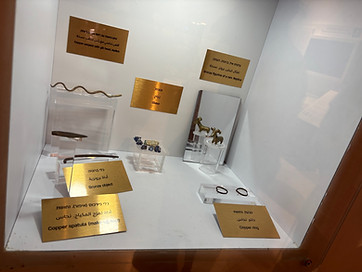
The copper snake as found in the temple by Solomon's Pillars shown in the Visitor Center
Solomon’s columns
Solomon’s columns have nothing to do with King Solomon, but are massive natural sandstone columns formed by erosion.
At the base of the columns, you will see the outlines of a temple, thought to be a 13th or 14th BCE Egyptian temple dedicated to Hathor, the Egyptian goddess of mining. Egypt later withdrew from Timna in around the late 12th century BCE. Nevertheless, copper production continued and the cultic space was reused and modified, probably by Edomites.
The temple contains a basin in the rear, standing stones behind the stone basin, and an offering table in the center. Findings have included the bones of sacrificed animals, fruit remains, clay and stone vessels, and interestingly a 12-inch copper serpent. The original of this is in the Eretz Israel Museum in Tel Aviv and a replica is displayed in the Visitor Center. It is of interest because a copper snake is mentioned in the Torah as being used by Moses for healing purposes against snake bites (Numbers 21:4–9). Copper snakes may have provided a path to the spiritual world.
High above the temple is a rock engraving dated to the time of Ramses III from the 12th century BCE in which the king is making an offering to the goddess Hathor. On the bottom are hieroglyphics that read something like: “This mining expedition operates under royal authority, is protected by the goddess Hathor—mistress of minerals and the desert—and seeks divine blessing for the officials and workers involved.”
It is possible to climb to the top of the columns for the view and this is recommended. The path starts behind the pillars by the Temple. The walk is minimally difficult but there are railings for support. You will descend to the other side of the pillars.

The Egyptian and then Edomite temple

The Mushroom

Climbing to the top of Somomon's Pillars

Workshops for copper production
The Mushroom
The Mushroom is a sandstone formation created by erosion. There are others like it in the vicinity. Close to the mushroom you will see the ruins of a center for copper production that has workshops and storage rooms for raw materials that has been dated to the 12 to 13th century BCE.
You will also see a copper smelting furnace. Charcoal was burnt with crushed copper ore, and air was pumped into the furnace through clay pipes to raise the temperature. This produced molten copper and left behind black slag. The numerous slag heaps near the Mushroom indicate that production here was on an industrial scale. This is one reason that Timna is considered a major metallurgical center and not just a small workshop.

Ascent to the Arches

Ancient pit for the extraction of copper-containing rock
The Arches
The Arches are natural rock openings formed by erosion of the soft red sandstone over millions of years and they offer dramatic views over the valley, the distant ridges and Mount Timna. This part of the park was an active mining area and there are ancient mining shafts and workings dating back some 3,000 to 5,000 years. Some are fenced off for safety, while others can be seen through grates or openings. You can also go inside a mining tunnel with steps and ladders providing access.
There is a looped trail that take you to the Smaller Arch, and if you continue on to the Great Arch. Short sections of the route have metal rungs and ladders bolted into the rock and you will pass through narrow passages through sandstone clefts. Follow the marked trail up a sandstone slope and you will soon reach the Small Arch. To the mining tunnels, continue along the loop into a narrow cleft. You will pass an ancient copper mining tunnel with visible tool marks. From the mining area you can walk to the Great Arch. Follow the loop downhill on a wider path and this will take you back to the parking area.

A mining shaft from the Egyptian period in the area of the Arches