Tel Arad National Park
On the same hill at Tel Arad are ruins from two distinct periods – a large city from the Early Bronze Age plus a small fortress from the time of the Judean monarchy. The Early Bronze Age is usually dated from between 3800 BCE to 2200 BCE. This city is dated to between 3000 to 2650 BCE and Arad is the only example in the world of an identifiable city from this period. It was then abandoned and no significant rebuilding of the city occurred after this. There are other examples of Early Bronze Age settlements in the Middle East, but they have invariably been covered over by later settlement. The appearance of this part of the city has been recreated with partial reconstructions and informative signs with pictures of how the buildings would have looked some 5,000 to 6,000 years ago.
Every English-speaking visitor and resident of Israel will benefit from my two books! Bestseller! "In and Around Jerusalem for Everyone - The Best Walks, Hikes and Outdoor Pools" and new! "The North of Israel for Everyone. The Best Family Activities, Hikes and Historic Sites" by Arnold Slyper — with essays, directions, maps, and much more.
For courier service from Pomeranz Booksellers in Jerusalem (tel: 02-623 5559) click here and here. For Amazon click here. To view details about the books and their outstanding reviews click here and here.
Directions: Enter “Tel Arad” into Waze.
Admission: : This is a site of the Israel Nature and Parks Authority. Summer hours are Sunday to Thursday and Saturday 8.00 a.m. to 5 p.m. and Friday and holiday eves 8.00 a.m. to 4.00 p.m. In the winter, closing time is one hour earlier. Entrance to the park closes one hour before cited closing time. Admission is 16 NIS for adults, 7 NIS for children, 14 NIS for students and 8 NIS for seniors. Their phone number is 08-6992447. This is their website.
Public transport: Enter “Tel Arad” into Moovit. There is a bus from Tzomet Arad. There is a 1.8-km/23-min walk to the tel from the closest bus stop.
What distinguishes an “Early Bronze Age” settlement?
Prior to the Early Bronze Age, in the prehistoric period, people lived in small villages. Domestication of crops and animals had taken place during the Agricultural Revolution throughout the world and people were engaged in agriculture.
The Early Bronze Age is characterized by urbanization. At Tel Arad one sees a well laid out city with city walls, gates, organized streets, and public buildings. In Mesopotamia, the first city-states that developed in this period were Uruk and Ur. In Egypt, there were early dynasties and monumental architecture, and in Anatolia metallurgy and trade. The production of bronze from copper alloyed with arsenic or tin was developed, and metal tools and weapons increasingly took over from stone.
This was also the time that writing developed — cuneiform in Mesopotamia and hieroglyphics in Egypt. However, writing did not spread to the Levant and we have no written records from this period. Our knowledge of history is therefore based entirely on archeology.
This was also a time of specialization. There were fulltime craftsmen, such as potters and metalworkers. Social stratification occurred and there were elites in addition to specialists and laborers. Cultic centers are seen here and also in Megiddo and Ai and these were serviced by priests. Long-distance trade networks were established.
As occurred in other settlements of the Early Bronze Age, Arad was abandoned in about 2300 BCE, and the population dispersed to small villages and seasonal pastoral camps. Why this occurred is unclear. It could relate to climate change with aridification, a shift to pastoral nomadism, or overextension of these early urban systems. But the bottom line is that we do not know. However, it did set the stage for an urban renewal in the Middle Bronze Age, in about 2,000 BCE.
TOURING THE TEL
THE EARLY BRONZE AGE CITY
The wall of the city was about 1,200 meter in length and 24 meter thick and was made of stone. It was possible to walk on top of the wall. Towers protruded from the gate. It was built at one time, strongly suggesting a strong centralized authority.

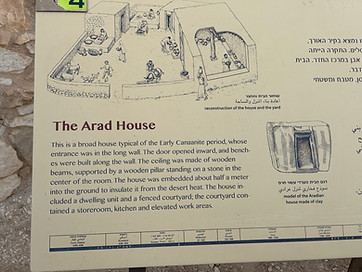
The houses had a uniform style in the style of the “Arad House,” and a partially reconstructed example is displayed. It was a stone structure. The floor was somewhat lower than street level to insulate it from the desert heat. There were stone benches along the walls. At the center of the hall was a wooden pillar that supported a flat roof of wooden beams. Adjacent to the dwelling area was a fenced courtyard containing a storeroom, kitchen and elevated work areas. A small clay model of a house was discovered in the excavations and this helped archeologists figure out how this house looked.


The Palace. This was a large complex of many rooms, cubicles and courtyards. Its location between the western city gate and the water reservoir suggested its governmental role.

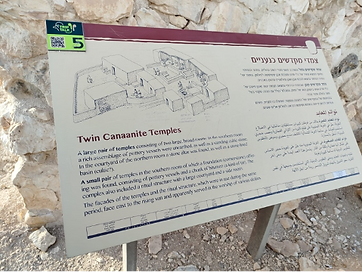
The Temples. Close to the palace is a complex of buildings surrounded by a stone wall that constitute a pair of large temples, a pair of small temples and a single temple. Each temple had a broad room with a yard similar to the “Arad House.” Similar temples were found at En Gedi from the Chalcolithic period and at Megiddo from the Early Bronze Age. Within the temples were found stone monuments, altars for sacrifices and ceremonial basins. The facades of the temples and its ritual structures faced east towards the rising sun. The presumption is that the multiplicity of temples indicates the worship of a multitude of gods.

Water Reservoir. Rainwater drained off the slope and was collected in a reservoir. A 16 meter deep well was dug within the reservoir during the Israelite period.

THE JUDEAN FORTRESS

A well from the Israelite period inside the Early Bronze Age reservoir.
Higher up on the hill is a small fortress from the 8th to the 6th century BCE. It measured only 50 x 50 meter and was one of a series of fortifications protecting the southern border of the Judean kingdom. During the monarchal period, six fortresses were built in Arad, one on top of each other. The last fortress was destroyed in 586 BCE during the Babylonian conquest. Four more settlements were built over this in the Persian, Hellenistic, Earlv Roman, and Early Islamic periods.
The first fortress was fortified by a casement wall while the five that followed had a solid wall. The entrance to the fortress was protected by a gate with two tall towers. The city had a planned street system, residential quarters, public buildings, and evidence of water management and storage.
Of considerable interest is a small Temple in the north-western corner that was in use concurrently with the Temple in Jerusalem. Its plan is the same as the Jerusalem Temple with an inner courtyard leading to the temple, and three steps from the courtyard leading to the Holy of Holies. The Temple is to the west of the courtyard, so that as in Jerusalem the Temple is facing towards the west, and not the east as in pagan temples.
In the middle of the temple courtyard is a square altar built of small stones and faced with unchiseled stones. This complies with the biblical prohibition against building an altar to God with hewn stones made by cutting tools (Exodus 20:25).
At the sides to the entrance to the Holy of Holies are two incense altars, one bigger than the other. Chemical residue analysis on the altars detected frankincense and cannabis resin mixed with animal dung (the latter likely used to aid combustion). The cannabis may have induced altered states of consciousness and enhanced ritual experience, suggesting sensory dimensions of worship not described in biblical texts.
Within the Holy of Holies are two monuments or matzevot, again one bigger than the other. It is not obvious in the photo graph below on the right that there are two monuments, since the smaller one is hidden behind the larger one. The picture on the lett shows that they were not formerly so and someone must have moved them. The issues are why are there matzevot at all and particularly why are there two? Even one is biblically forbidden, and certainly two (Deuteronomy 16:21-22)!
One suggestion is that the One God was thought to have a female partner. In the Sinai Peninsula on storage jars and plaster walls have been found the sentences “I bless you by Yahweh of Samaria and his Asherah” and “I bless you by Yahweh of Teman and his Asherah.” In Khirbet el-Qom, in the Judahite Shephelah, on a late 8th century tomb was found the inscription “Blessed be Uriyahu by Yahweh, and from his Asherah he has been saved.” The phrase Yahweh and his Asherah suggests that some Judahites understood Yahweh’s worship as involving an associated Asherah—whether this be a goddess, symbol or cultic object. These texts provide the closest textual parallels for interpreting the paired standing stones in the Arad temple. Alternatively, the second smaller standing stone or matzevah represents a symbol of Yahweh’s presence, and not a second deity (even though forbidden).
This Temple went out of use in the late 8th century BCE and the entire site was covered over. This may well have been due to the religious reforms of King Hezekiah, who attempted to make the Temple in Jerusalem the sole place of worship for the Judeans. He may also have been concerned that the worship of God in out-of-the-way places was no longer pure monotheism.

In this picture, the two incest altars and matzevot are clearly seen.

In this picture, the second matevah is hidden behind the larger one.
Elyashiv House. There is nothing unusual about this house close to the southern wall of the fortress other than it contained an archive of ostraca written mainly in ancient paleo-Hebrew. Seventeen were addressed to Elyashiv, apparently the commander of the fortress.


The Water Facility. This is located close to the Temple and consists of three excavated and plastered cisterns. The original staircase leading to them has only partially survived.