This is an attractive and well-laid out circular trail in Britannia Park with interesting things to see along the way. This area was quite extensively habited in former times. There are two circular trails – a shorter and a lengthier trail. The shorter trail overlaps a bit with the trail in the park to Tel Azeika described on another page. There are many cisterns along the trail, although wells are only seen on the longer trail.
The two Israel travel books that everyone was waiting for!
Bestseller! "In and Around Jerusalem for Everyone - The Best Walks, Hikes and Outdoor Pools" and new! "The North of Israel for Everyone. The Best Family Activities, Hikes and Historic Sites" by Arnold Slyper — with essays, directions, maps, and much more.
For courier service from Pomeranz Booksellers in Jerusalem (tel: 02-623 5559) click here and here. For Amazon click here and here. For details about the books and their outstanding reviews click here and here.
BOTH HIKEs:
Time: About 2 hours for the shorter trail and 2¼ hours for the longer trail
Distance: About 3.7 km for the shorter trail and 3.9 km for the longer trail
Type of walk: Circular
Difficulty: There is a moderate elevation to Tel Shkalon. The trail overall is slightly difficult with some walking on bare rock and maneuvering around boulders, although there is no actual climbing over rocks and no area is that difficult. Walking poles can be helpful for balance.
Directions, starting point and parking: Enter “חניון בור המים “ into Waze and click on “חניון בור המים Beit Shemesh.” You will be entering Park Britannia from Route 383. The entrance to Park Britannia is not well marked, although there is a left-turn lane. Just after a 4-way interchange in the park, there is a dirt parking area on your right. You will recognize the beginning of the trail by the presence of a cistern, a red-marking, and a sign in Hebrew describing the trail. There is a picnic area adjacent to the trail head with shaded picnic tables, but no restrooms.
Public transport: It is about a 1.6-km/20-minute walk from the closest bus stop at Ha’Elah Junction.

THE TRAIL:
-
Note the water cistern just before the trail.
There are many cisterns in this area because of the paucity of springs. The rock in this area is chalk. This is a soft rock and it is relatively easy to carve out cisterns. In addition, this rock is impermeable, and there is no leakage of water from the cistern. Rain water was led by channels from higher surrounding areas into the cistern.
-
Follow the red-markings in the direction of Khirbet Shkalon. About half-way, the trail passes a small cave whose entrance is covered by a metal grate. You can turn right by stone steps and climb a low hill to the ruins of Khirbet a-Rasam, although it is off the marked trail. These are the uncovered remains of a rural settlement.
The site has been excavated and there are remains from the Israelite period, and a manor house from the beginning of the Hellenistic period. This was later converted into an inn. It was resettled by Jews in the Roman period. However, there is little to see and it can easily be given a miss.
-
A bit further along is the Rita Kay Picnic Area with shaded picnic tables.
-
You will soon pass a rock-hewn winepress, attesting to the importance of viticulture and wine production here.

Ancient winepress

The Rita Kay P:icnic Area
-
This church may be the one depicted on the Madaba map. This map shows the settlement of Beit Zechariah, whose name is preserved in the former Arab village of Zakariyya (and the nearby moshav of Zechariah). The map shows a splendid church called “Zion of Saint Zechariah,” possibly commemorating the father of John the Baptist.
This church may be the one depicted on the Madaba map. This map shows the settlement of Beit Zechariah, whose name is preserved in the former Arab village of Zakariyya (and the nearby moshav of Zechariah). The map also shows a splendid church called “Zion of Saint Zechariah,” possibly commemorating the father of John the Baptist.
-
Descend on the still red-marked but now also Schvil Yisroel trail. It is marked by a wooden pole with a Schvil Yisrael sign. You will pass another rock-hewn winepress.
-
You will eventually come to a paved road. There is a large Palestine oak tree at this intersection.
-
For the longer trail, cross the road and continue on the red-marked trail down the valley. You will see many orchard trees, two wells covered by a metal grate, and the ruined village of Ajjur. Prior to the War of Independence this was one of the largest Arab villages in the Shefelah. Towards the end of the trail, there is a Y-fork. The jeep trail on the left is easier than the red-marked trail on the right. Both lead to the parking lot and your car.
-
For the shorter hike, turn right onto the green-marked paved road. At the next 3-way intersection follow the green trail to the left, and shortly after this turn left again. The green marking is on a pole at the side of the road. You will pass two observation areas that provide nice views over the coastal plain and its cities, including Ashkelon and Ashdod. Signs provide identification. This green-marked road lead you to your starting point and your car.
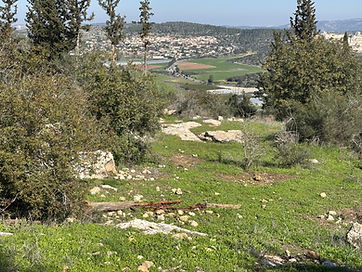
Moshav Zechariah viewed from the summit of Khirbet Shkalon.

The Elan Valley viewed from the summit of Khirbet Shkalon.

Map showing the short and long trail