Floating and walking in the town of Ein Bokek
Ein Bokek is an unusual town. Situated on the western shore of the Dead Sea just north of Mount Sodom and 400 meters below sea level, it was established in the 1970s and 1980s as a hotel zone and not as a conventional town with residential neighborhoods. It is named after nearby Nahal Bokek. Much of its business is health tourism, and most of the hotels include medical spa facilities. The high salinity of the Dead Sea, its mineral-rich mud, reduced ultraviolet radiation, and high atmospheric pressure are thought to be helpful for such conditions as psoriasis, arthritis and respiratory disorders. Although considered to be on the Dead Sea, the town is actually located by a large evaporation pool. Water is pumped into this and other evaporation pools of the Dead Sea Works from the northern basin, which is considerably deeper but has a somewhat lower-water level.
The two Israel travel books that everyone was waiting for!
Bestseller! "In and Around Jerusalem for Everyone - The Best Walks, Hikes and Outdoor Pools" and new! "The North of Israel for Everyone. The Best Family Activities, Hikes and Historic Sites" by Arnold Slyper — with essays, directions, maps, and much more.
For courier service from Pomeranz Booksellers in Jerusalem (tel: 02-623 5559) click here and here. For Amazon click here and here. For details about the books and their outstanding reviews click here and here.
Ein Bokek has a popular public beach with outdoor showers, restrooms, shaded areas, and lifeguard.
Those intending swimming, or more accurately floating, are advised to put on footwear to protect again salt crystals and rocks, to keep their head above water at all times, and to shower immediately after swimming to remove mineral residue. It is advisable not to shave beforehand or to enter the water if one has cuts or skin issues. On the other hand, the magnesium-rich sea water enhances skin hydration and reduces inflammation in atopic dry skin. Mud treatment and mineral baths enhance these benefits.
Because of its lack of residents, do not expect any town nightlife.
A 1-km promenade runs parallel to the lake directly in front of Ein Bokek’s line of spa hotels. It connects hotel entrances, beaches, cafés, and treatment facilities. It sits atop raised embankments and engineered foundations, and serves as a buffer between hotel structures and the dynamic shoreline.


The Dead Sea
The Dead Sea is the lowest exposed point on earth, being more than 430 meters below sea level. It is one of the most saline lakes on earth, and is 10 times more saline than the ocean. It is situated at the heart of the Jordan Rift Valley, and was formed by millions of years of tectonic motion of the African Plate and the Arabian Plate that created a deep pull-apart basin that gradually subsided far below global sea level.
In the past during wetter climatic periods, the basin held a much larger lake called Lake Lisan, and shoreline terraces visible today on the cliffs mark former lake levels tens of meters higher than the modern surface.
In ancient times, the Dead Sea was used for its salt and bitumen (asphalt), and the latter was regarded as a particularly valuable product. It is a naturally occurring petroleum-based substance. It was collected in boats and transported throughout the Near East and Mediterranean. Its used included sealing boats and ships, waterproofing, as a binding material in brick and stone construction in place of lime mortar, for Egyptian embalming practices, and for medicine and cosmetics.
The sea is divided today into two basins — the northern basin, which is deep and natural and contains most of the remaining water, and the southern basin, which has been largely converted into shallow ponds used by the Dead Sea Works for evaporation.
Because of the diversion of the Jordan River and its tributaries the water level in the Dead Sea is dropping by about one meter a year, and thousands of sinkholes have formed as underground salt layers dissolve. This is an ecological challenge, which is thought about but not yet addressed.

The much higher water level millions of years ago is reflected by shoreline terrances.
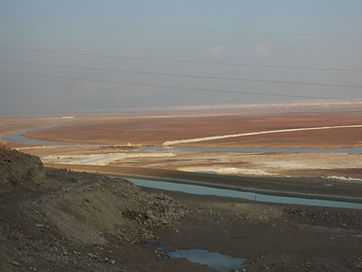
There are two channels between the northern and southern basins. The former discharges pumped water into the evaporation pools, while the latter returns some of this water to the northern basin.by gravity.